

The Future is Everyone
A blog for International Men’s Day – Thursday Nov 19th – by Mandy Marshall
One of the questions I am frequently asked when celebrating International Women’s Day on March 8th is ‘When is International Men’s Day?’ – usually in a sarcastic tone. Well, the answer is – since 1999 – November 19th. To be fair, it is only in the last ten years or so that it has been gaining international prominence and attention. The aim of International Men’s Day (IMD) is to celebrate men in your life and those making a positive contribution in your family, communities and around the world, and encouraging men to access the health care needed to support their wellbeing and flourishing.
The male stereotypes of ‘being strong’, ‘not being vulnerable’ and not seeking out healthcare when needed are still prevalent in many countries and communities. As a result, men often do not seek out the help, support and assistance they need, especially around their physical and mental health. Globally, more men die by suicide than women, die younger, are more likely to be homeless, and in conflict zones boys are at risk of being child soldiers.
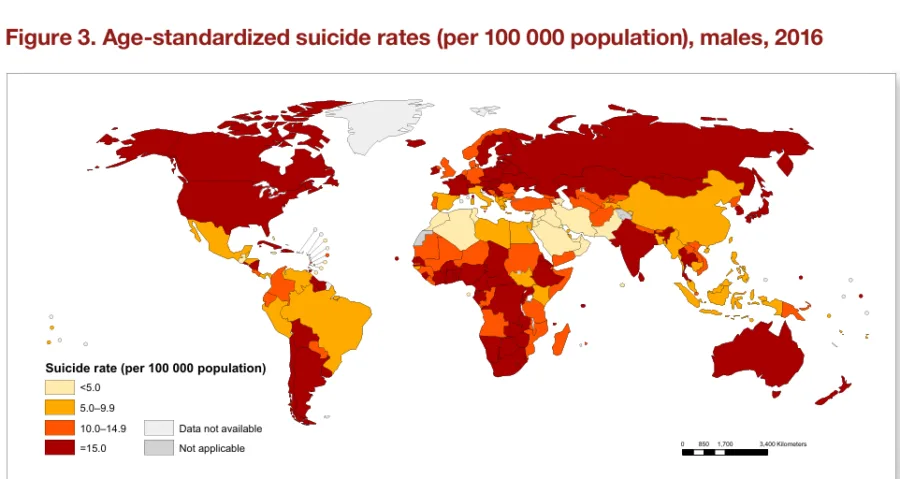
Source: WHO, Suicide in the World, 2016.
We need to talk, men
These global statistics clearly show that men need to start talking and to talk to one another. Creating a safe space where men can talk to each other and be themselves is a first step. Many churches have men’s groups, men’s breakfasts, or in the case of my own church ‘Men’s Pints’ where men in church meet on a Friday once a month to chat and get to know one another. It is a typically British thing to do, so what would be culturally acceptable in your context to bring men together?
A safe space is important to build up the friendships between men so that it leads to trust, honesty and vulnerability in order that men can share their struggles and challenges and find support and advice to address the situation. We are not designed to live in isolation nor independent from one another. We need one another to walk together through life’s ups and downs, to be a support when life gets hard, and to cheer you on when things are going well.
The Anglican Alliance is playing its part in creating space for men to reflect on the culturally assigned stereotypes and traditions that impact on who we are. We are created in the image of God and designed to flourish into all that God created us to be. The Men and Masculinities programme creates space for men to come together, reflect on society, culture, tradition and scripture and to discuss what is good and what needs to change. This starts with our identity in Christ and recalling and remembering who we are and meant to be. This is often counter cultural in a world that measures success as a key indicator of life achievements. Yet what success looks like in the eyes of God is not necessarily the success the world tells us we should be seeking. For example, we are subtly informed that we need to own our own house, have a car, the latest gadgets, seek to be comfortable or rich etc. And yet when we compare that to Jesus those so-called indicators of success fall to the ground and count as nothing. Jesus didn’t own his own home, didn’t have a car, nor gadgets, didn’t marry, didn’t have children, was financially supported by women.
So, the question is, who are we following? Society’s expectations or Jesus?
The challenge for this International Men’s Day is to ask your mate, buddy, friend, if they want to talk. Ask if they are OK and let them know it’s OK not to be OK.
To support the work of the Anglican Alliance on Men and Masculinities and other gender justice issues, see here.
Mandy Marshall
Gender Justice Senior Adviser
November 2026