
As the first pilot of A Place at the Table – Reimagining Power Through Every Voice begins in São Paulo, Brazil, the Revd Rodrigo Espiúca reflects on listening, power and the courage to step out of the boat.
“Courage! It is I. Do not be afraid.”
These words of Jesus, spoken to frightened disciples in a boat battered by wind and waves, were at the heart of a sermon preached in Brazil on Sunday 9 August by the Revd Rodrigo Espiúca, a priest in the Diocese of Brasília and a member of the Anglican Alliance staff team.
They are also fitting words with which to begin an important new journey for the Anglican Alliance: the first pilot of A Place at the Table – Reimagining Power Through Every Voice, taking place in São Paulo in August 2026.
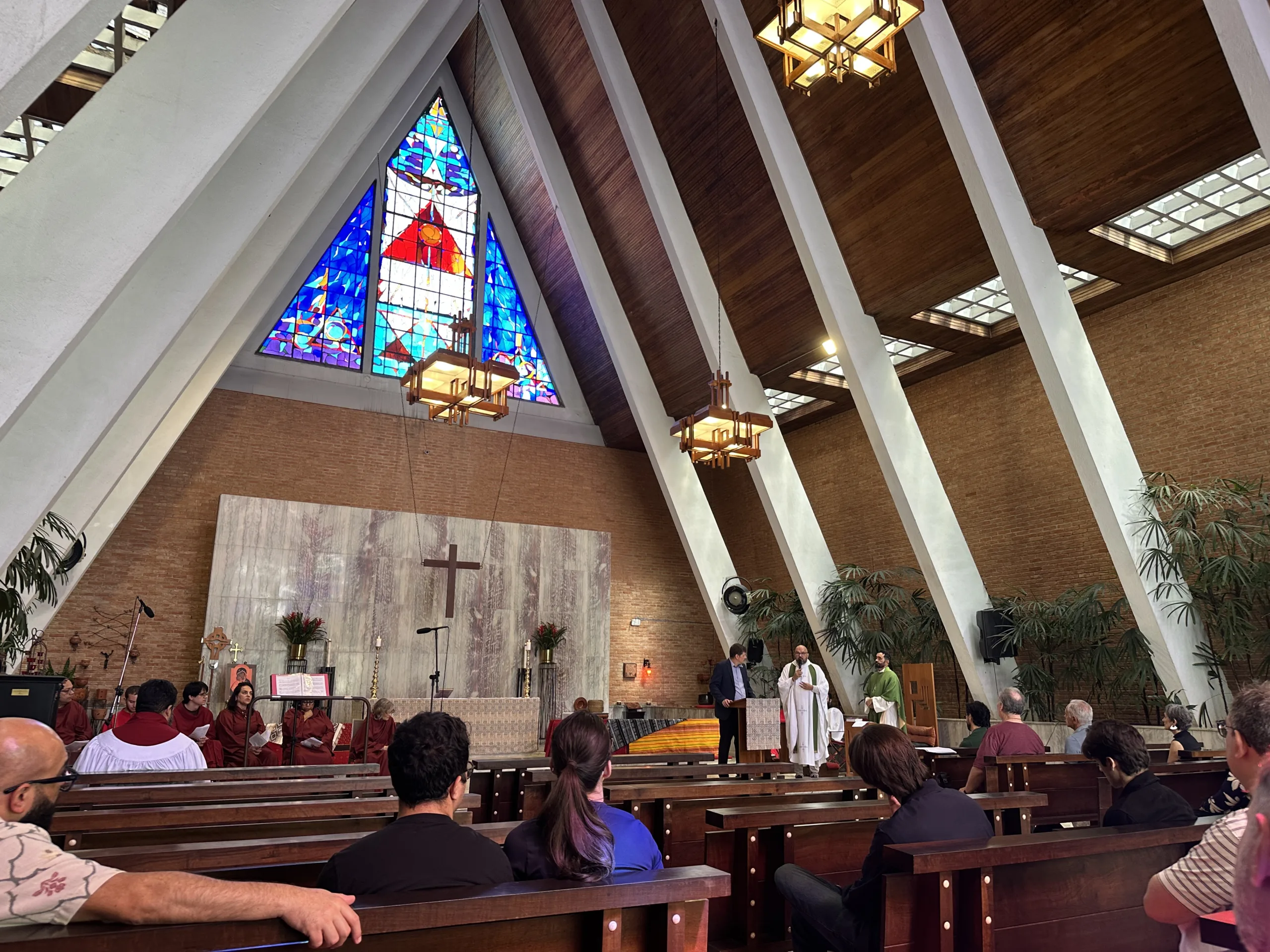
The pilot brings together participants from North, Central and South America, the Caribbean and other parts of the Anglican Communion. It is hosted by the Diocese of São Paulo and held in the Anglican Cathedral (pictured).
The week begins with a significant moment in the life of the Anglican Communion: from 10–12 August, Primates and Provincial Secretaries from across the Americas and the Caribbean will gather together in São Paulo. It is the first time such a regional gathering has taken place, creating a new space for relationship, conversation and shared discernment across the Provinces.
The gathering has been made possible through the relationships and convening work of the Anglican Alliance, reflecting its wider role in connecting people and Provinces across the Communion. The three days have their own agenda and are separate from A Place at the Table.
From 13–15 August, the A Place at the Table pilot then begins with a three-day immersive envisioning. Some of the Primates and Provincial Secretaries will stay on and will be joined by other senior leaders from across the region and beyond. Together, they will experience A Place at the Table rather than simply hear about it – exploring its approach to deep listening, reimagining power and enabling communities to discern and act on the issues that affect their flourishing.
The following week, from 17–21 August, the first cohort of A Place at the Table Master Facilitators will undertake a five-day formation programme, equipping them to take the process into their own dioceses and regions.
Learning to hear the quieter voices
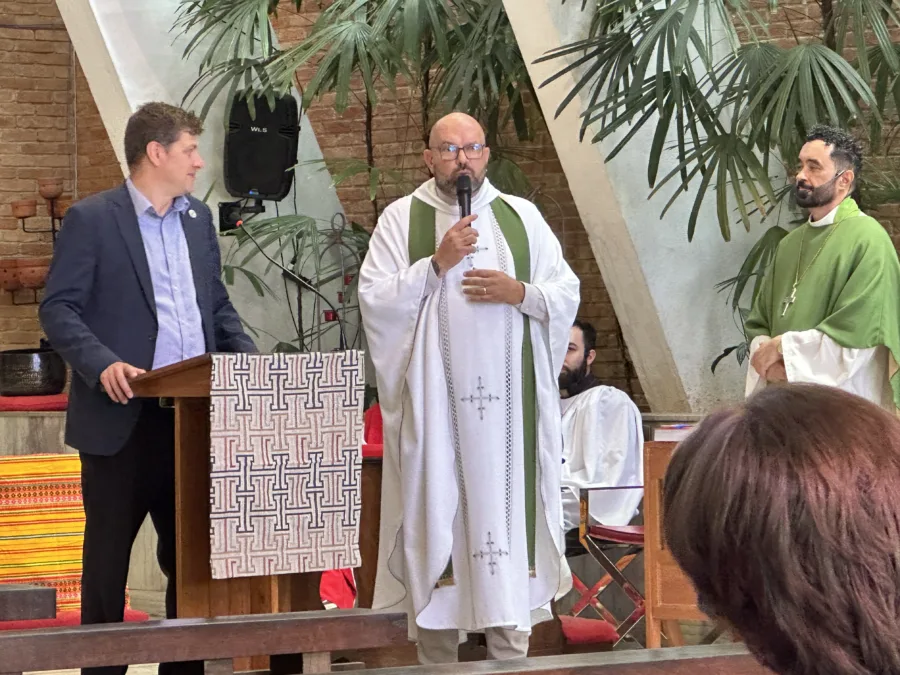 Preaching from the lectionary readings for Sunday 9 August, Rodrigo reflected particularly on Elijah’s encounter with God in 1 Kings 19.
Elijah does not find God in the violent wind, the earthquake or the fire, but in what Rodrigo described as “a soft voice, a murmur, the sound of profound silence”.
Rodrigo reflected: “We live in a society fascinated by noise. Whoever shouts the loudest seems to be right. Those who possess more power seem to have authority.”
The temptation is present even within the Church, he said, when “we confuse faith with power, spiritual authority with domination, Christian witness with imposition.”
But Elijah’s encounter with God reveals another understanding of power: “God does not need violence to be powerful. The God of Scripture can be found in the voice we can barely hear.”
That conviction lies close to the heart of A Place at the Table.
The initiative is rooted in Christian faith and in the lived experience of communities across the Anglican Communion. At its heart is a conviction that many of the challenges facing our world are shaped not only by a lack of resources, but by distorted relationships of power: who is heard, who makes decisions, who benefits and who is excluded.
A Place at the Table therefore creates spaces in which churches and communities can listen deeply to lived experience, recognise God-given agency, analyse power, imagine alternatives and act together for change.
For Rodrigo, listening is itself part of the Church’s vocation. “Perhaps that is why one of the most important tasks of the Church is precisely to learn how to listen.”
He called the Church to listen to people whose voices have been silenced: people living in poverty; women experiencing violence; Indigenous peoples and traditional communities; migrants and refugees; children and older people; and “those whom our society has decided don’t matter”.
And listening, he said, must extend to creation itself: “The rivers are speaking. The forests are speaking. The oceans are speaking. The climate is speaking.”
Perhaps, he suggested, the problem is not that there are no signs.“Perhaps we are making too much noise to hear them.”
From listening to action
Deep listening is only the beginning.
The six-stage journey at the heart of A Place at the Table moves from inward and outward listening into envisioning change and analysing power, and then into strengthening connections, releasing action and building forward together. Crucially, the priorities for change are not imposed from outside. They emerge from the experience, wisdom and discernment of communities themselves.
Rodrigo’s sermon offered a powerful theological expression of that movement from faith to action.
Reflecting on St Paul’s words in Romans – “How beautiful are the feet of those who bring good news!” – he argued that evangelism cannot be separated from the way Christians live in the world.
“Evangelizing doesn’t just mean talking about Jesus. It means making the Good News of Jesus visible.”
Defending the dignity of a person under threat is proclaiming good news, he said. So is welcoming those who have been rejected; confronting racism, violence and discrimination; protecting a spring; restoring degraded land; or planting a tree for generations we may never meet.
This understanding of mission is also woven through A Place at the Table. Rooted in Scripture and the Anglican Five Marks of Mission, A Place at the Table seeks to connect Christian faith with the realities communities face: poverty and inequality, violence and exclusion, environmental degradation and the structures of power that can prevent people and creation from flourishing.
Having the courage to leave the boat
Towards the end of his sermon, Rodrigo returned to the Gospel and to Peter’s extraordinary decision to step out of the boat.
The boat, he reflected, matters. It represents “our structures, our traditions, our temples, our institutions”. These things have value.
“But there are times when following Jesus means getting out of the boat.”
And when Peter begins to sink, Christ reaches out his hand.
For Rodrigo, this offers a beautiful image of the Church:
“We are not a community of people who never sink. We are a community of people who have learned to reach out to one another because they first experienced the hand of Christ sustaining us.”
That image speaks powerfully as this first A Place at the Table pilot gets under way.
The two weeks in São Paulo are deliberately a pilot: a time for experiencing, learning, listening and discovering together. Senior leaders are invited to experience the process themselves; a first cohort of Master Facilitators will then be formed to accompany churches and communities through it.
A Place at the Table does not begin with the assumption that the answers lie with those who hold the greatest institutional authority. It begins by creating space to listen: to God, to one another, to communities, and particularly to voices that can too easily go unheard.
And it asks what might become possible when power is exercised differently – when people discover their own agency, when leadership creates space for others to flourish, and when churches and communities imagine and act for change together.
As this new journey begins in São Paulo, perhaps Rodrigo’s final invitation to the congregation offers an invitation for A Place at the Table too:
“Let us be a Church that has the courage to leave the boat.
A church that listens before speaking.”
And, amid all the uncertainty that accompanies any new beginning, there are Christ’s words across the water:
“Courage! It is I. Do not be afraid.”
Read the full sermon
The Revd Rodrigo Espiúca preached this sermon on Sunday 9 August 2026, reflecting on 1 Kings 19:9–18, Psalm 85:8–13, Romans 10:5–15 and Matthew 14:22–33.
